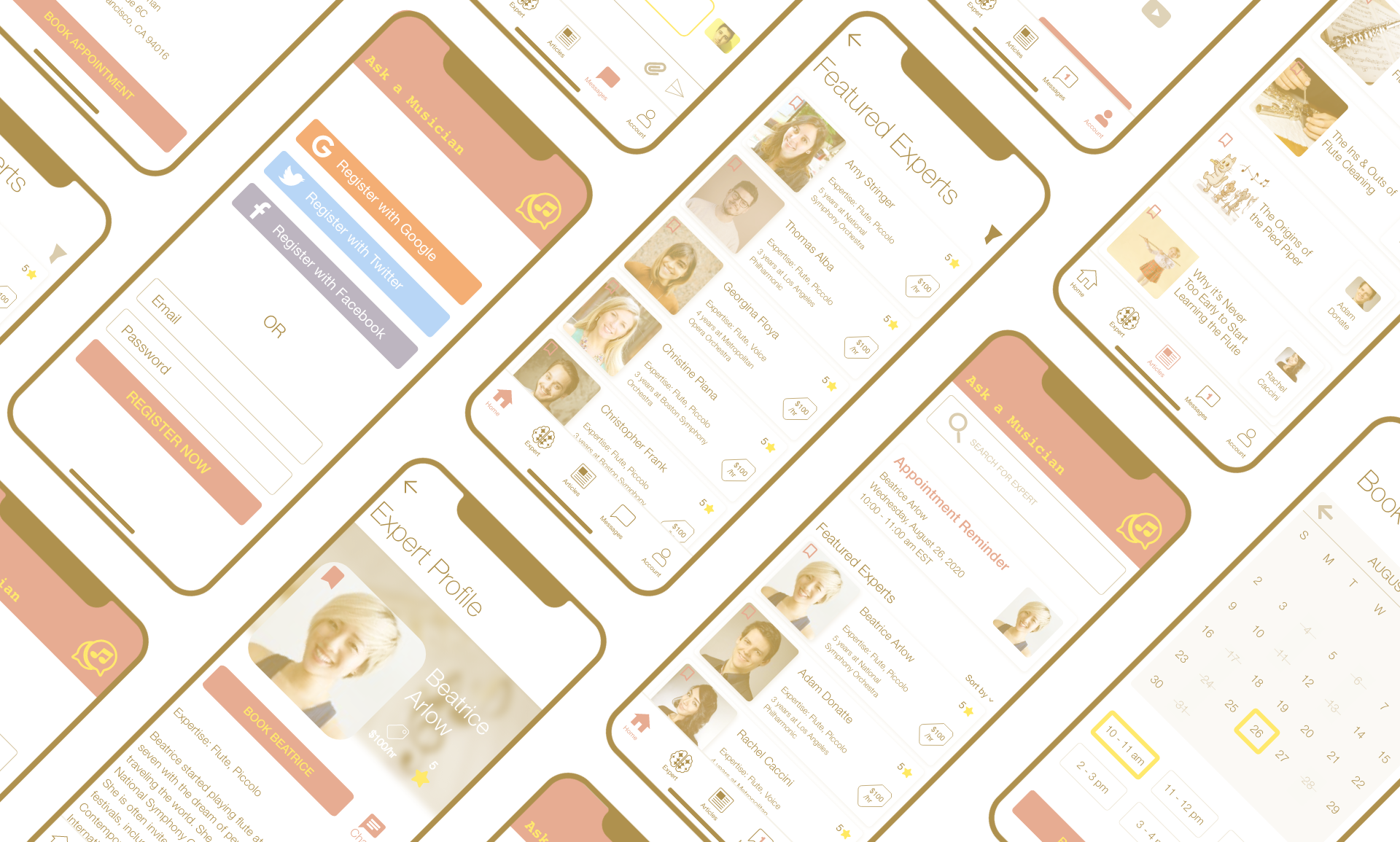
Ask a Musician
Overview
I was tasked with creating an expert focused application for CareerFoundry’s UX Immersion portion of the design course. With my background in music, I thought to create a product for musicians of various levels to contact expert musicians about any music-related topic, from taking lessons for specific instruments to learning more about music theory or history.
Roles and Responsibilities
I was the sole designer for this project and was responsible from the idealization to the creation of the high-fidelity prototype. Here is a listing of my responsibilities:
Problem Statement
Beginning and amateur musicians need an easy way to communicate with professional musicians to improve their musicianship skills and seek music advice.
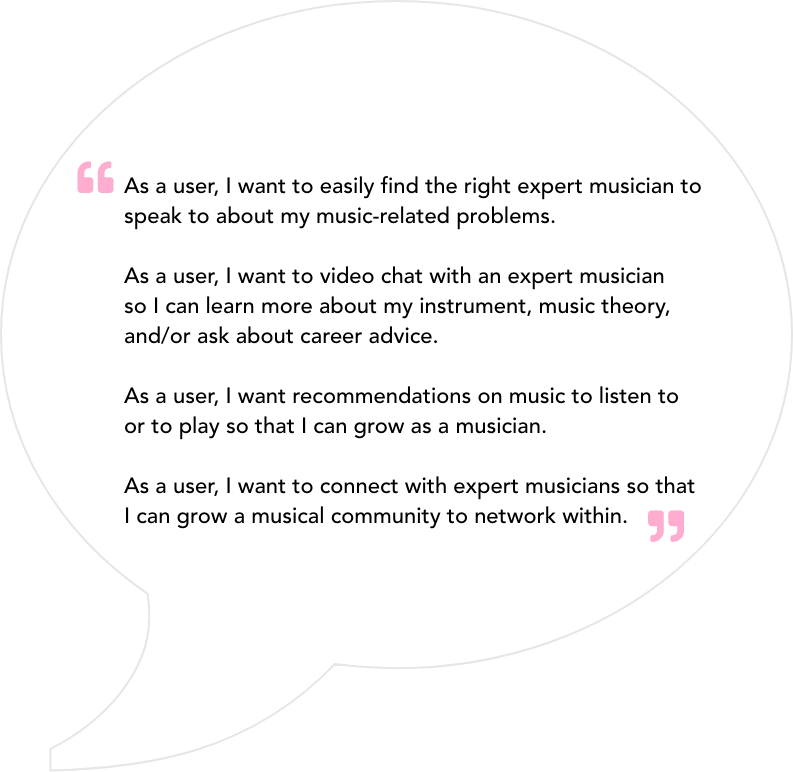
User Stories
Competitive Analysis
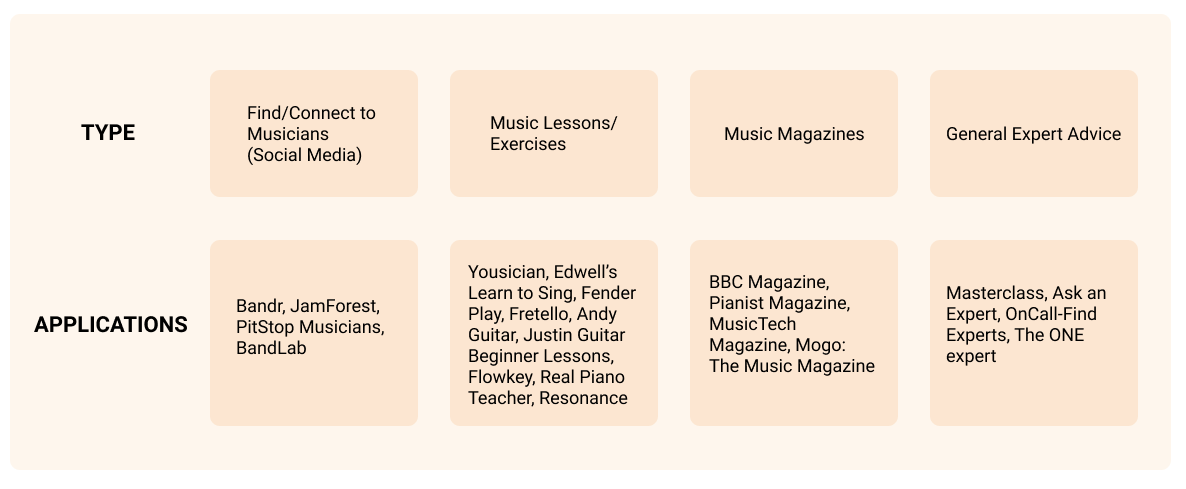
Research into music- and expert-related applications was first investigated before the creation of the Ask a Musician application. The types of available applications seemed to fall within four categories: social media for musicians, music lessons and exercises, music magazines, and generic experts. The only application similar to my idealized application was Resonance, a professional artist/coach for hire application.
The chart below is a brief overview of the applications available.
Obtaining information on what is available as well as the quality of the available applications allowed me to plan a better user experience and product. Therefore, I focused on looking at three different applications that cover the overall categories: Resonance, The One, and Fender Play. The results are summarized in the SWOT chart below:

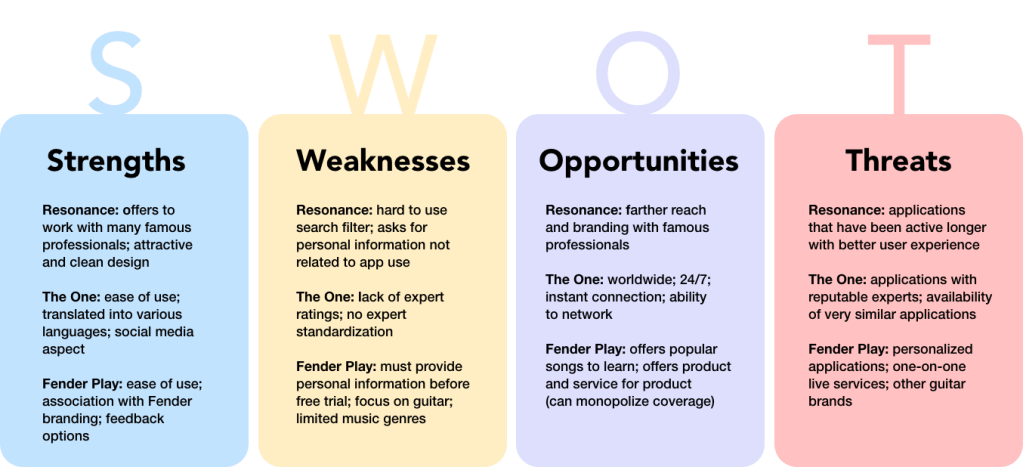
Insights:
Competitive Analysis
There seemed to be a lack of applications that focused on communicating with only expert musicians with a variety of music genres.
Standardization of expert level musicians was based on association with companies, awards, and/or with institutions. This is a music industry standard, so it would be appropriate for a music-related application to do the same.
Branding and user experience plays a large role due to the large selection of all the different types of musician-related applications available. It seems that these factors were placed at the forefront to reach new users.
User Interviews
From the competitive analysis, I planned to encompass a larger range of musical topics/instruments and seek experts with standard professional experience for the application.
I interviewed users with the following goals in mind:
- Identify music topics/categories that users have interest in
- Identify current sources of music information from users
- Identify how users use music in their daily lives
- Identify user behaviors/habits related to music
Below is one of the four user interviews I conducted:
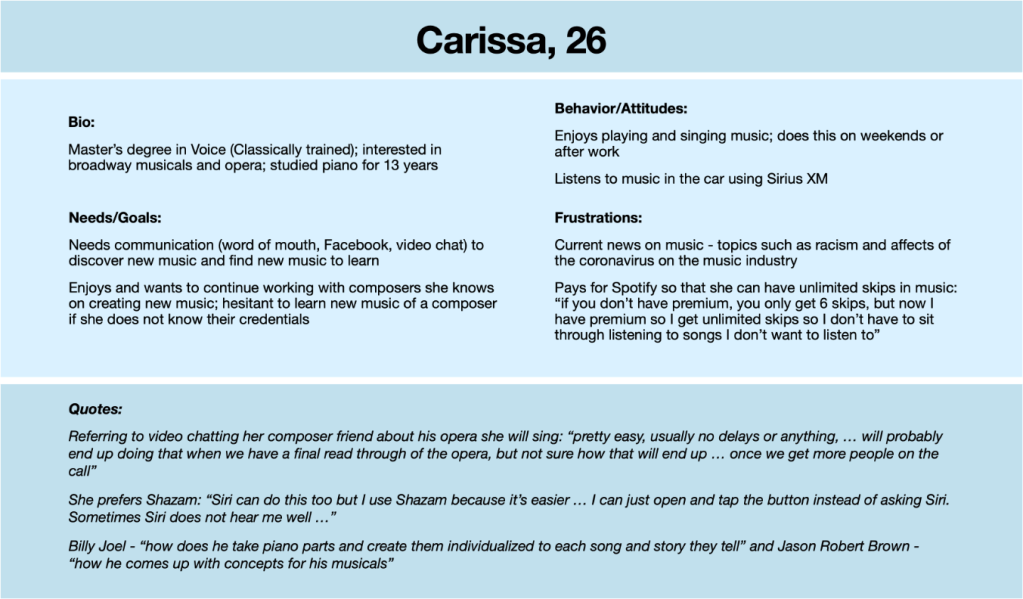
Insights:
User Interviews
Depending on the level of music knowledge, goals vary in relation to music. Active musicians seem to focus on techniques and sheet music while people who listen to music seem more interested in the context of the music (history of the song, how the song reflects the artist, etc). Therefore, musicologists would be a useful addition as an expert in an application (they study the history of music).
Past music listening influences present music listening. Therefore, having known artists on an application would be beneficial for bringing more interest to the application.
Social media and word of mouth are the primary forms of music discovery.
Newsfeeds are a good source of information, so there is benefit in tailoring articles by interest.
Many people already use their phones for music listening and reading music news.
Music is involved in many aspects of peoples’ lives as an active and passive activity starting from an early age and continuously used with age. Therefore, there is a need for music, but music learning and information may not always be a necessity. It is more of a hobby/entertainment form itself but can be expanded into a more social activity since users learn from others about more music.
User Persona & Customer Journey Map
I created user personas based on my initial research results to help in focusing on the target audience for the Ask a Musician application. The intended user persona is shown below.
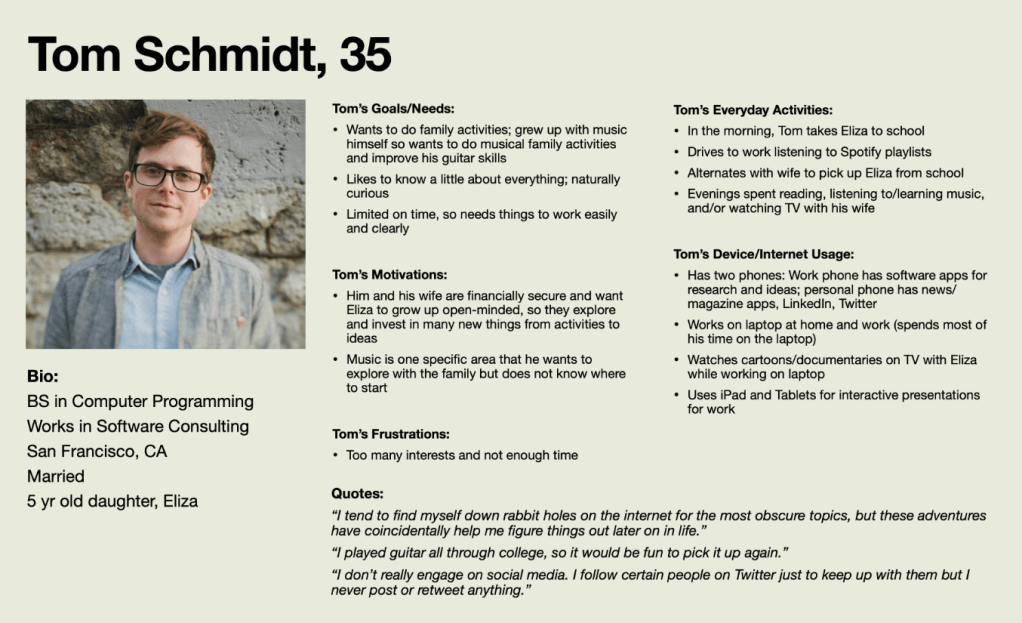
Tom Schmidt would want to use the Ask a Musician Application for ideas to create more family time. The manner in which he would use the application is described:
Scenario: Tom wants to learn more about how to involve his daughter in family musical activities and needs training and advice.
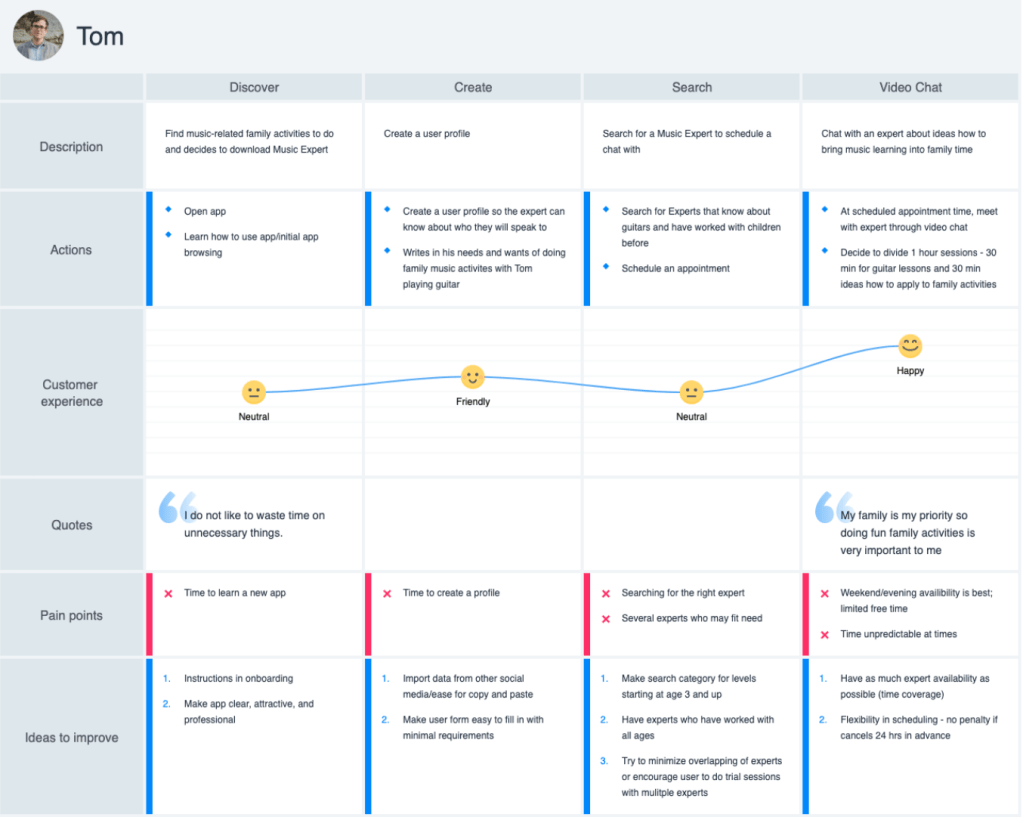
Tom’s Customer Journey was created using FlowMapp in the chart below.
User Flow
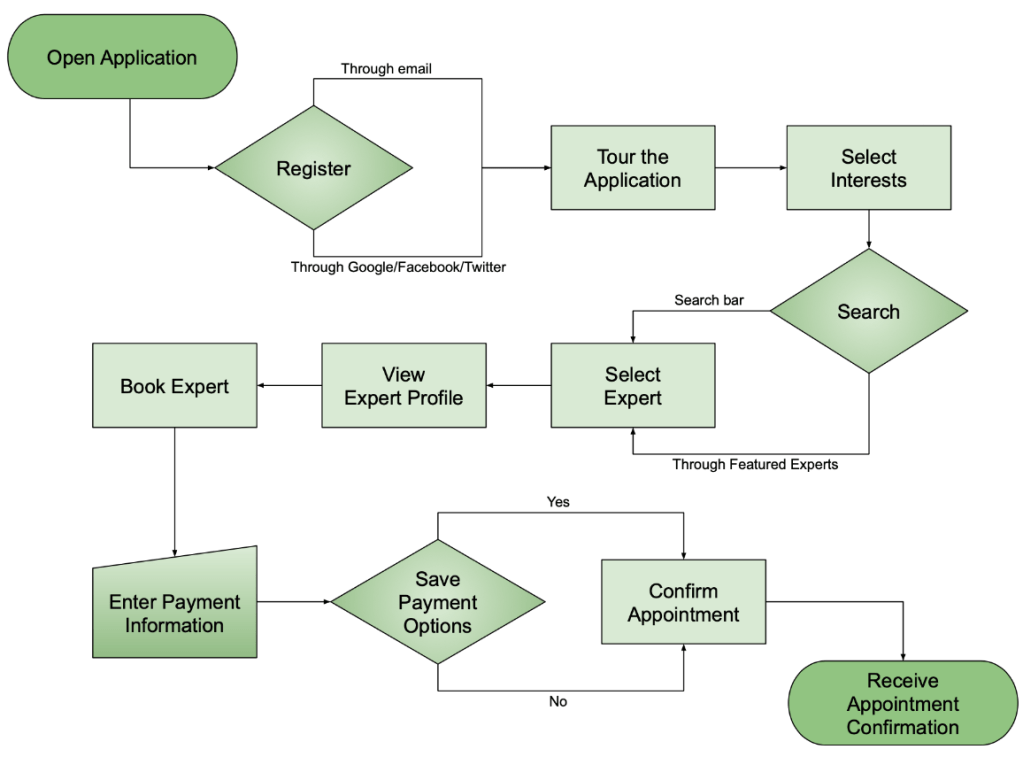
Based on Tom’s customer journey map, I created user flows on how he would use the application for his needs. The user flow below shows his process to complete booking an appointment with an expert musician.
Card Sorting
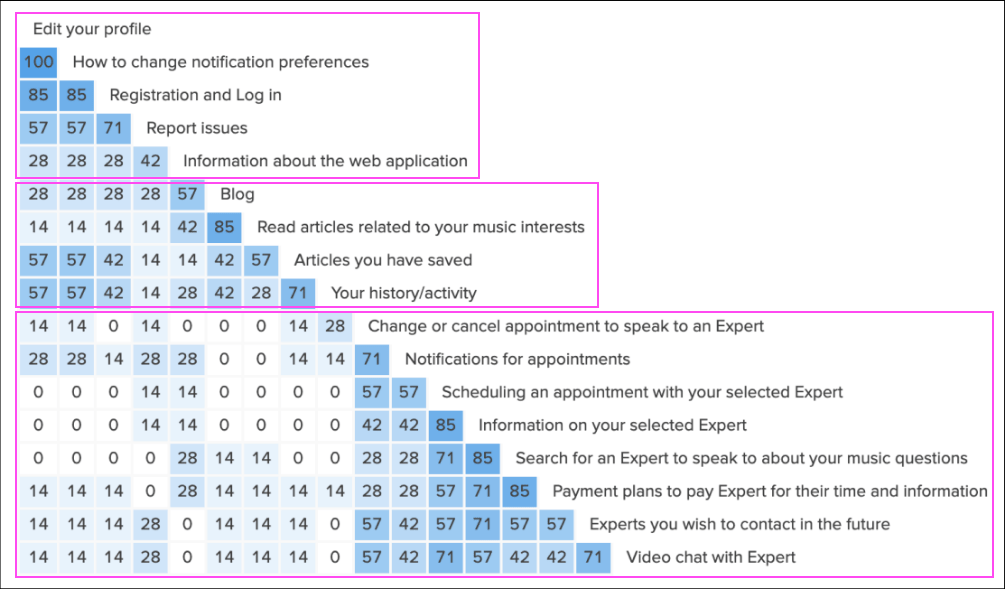
The next step was to begin structuring the information architecture of the application. I used OptimalSort to ask seven participants to open sort 17 cards with the important application features. The OptimalSort Similarity Matrix showed that there are roughly three main categories: Account information, Articles/Blog, and Experts. These are boxed and highlighted in the image below.
Sitemap v1
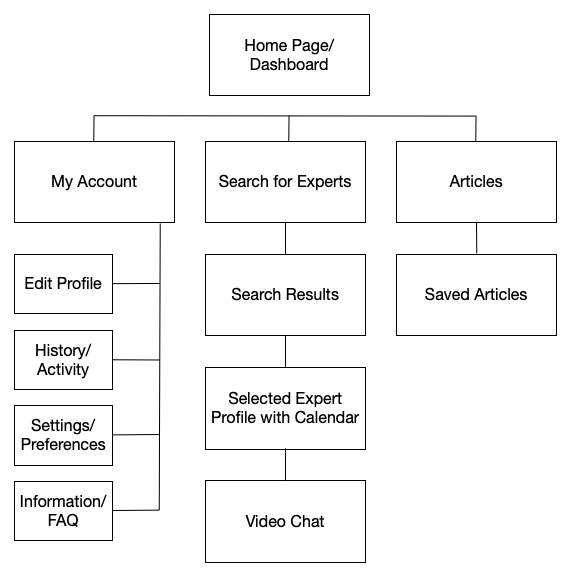
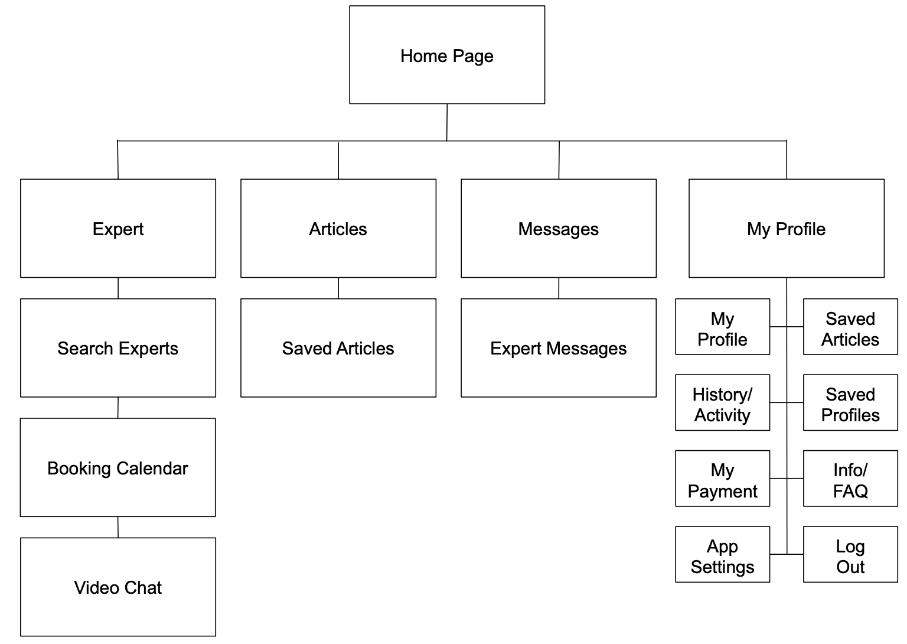
The navigation sitemap was thus based off of the card sorting results with three main categories.
Rapid Prototyping
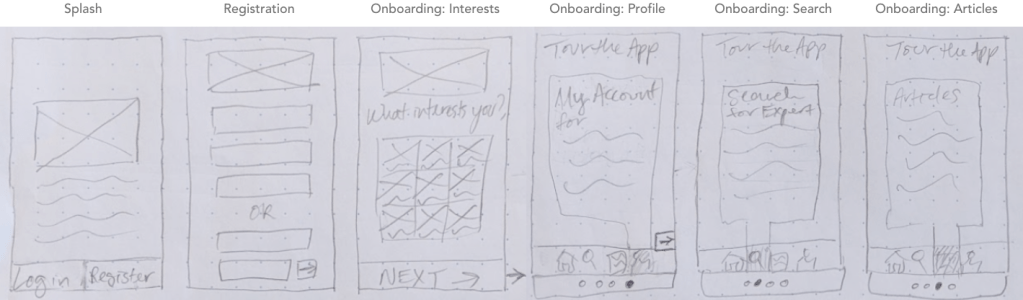
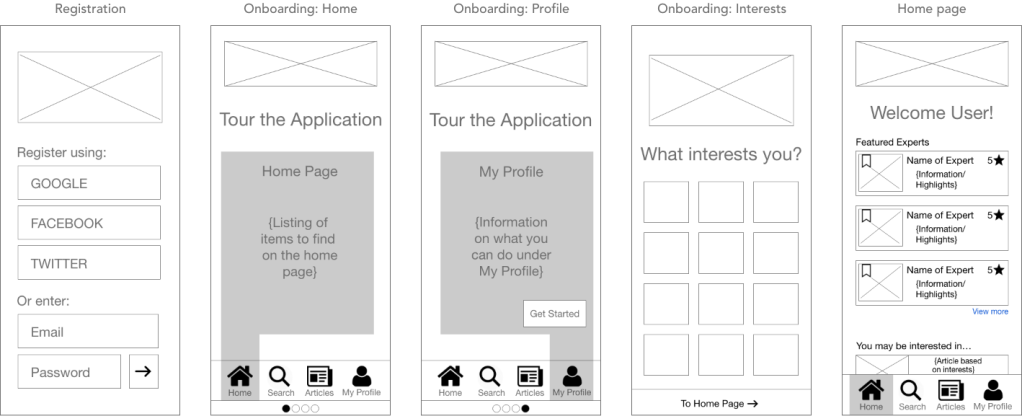
Once the navigation was completed, I moved onto rapid prototyping. While rapid prototyping is an iterative process, I wanted to briefly describe some of my progress. I started with pencil sketched low-fidelity wireframes, including different ideas to create different screens. Once I was done brainstorming, I selected the best low-fidelity wireframes to be digitalized and upgraded to mid-fidelity wireframes. With each upgrade, I added more details and features available on the screens.
Sitemap v2
The navigation sitemap was upgraded after the low- and mid-wireframes. It became clear that an expert messaging section was needed for easier accessibility. Therefore, a user could quickly access the separate messaging if need be. In addition, the user account section was expanded to include a variety of options.
High-fidelity Wireframes v1
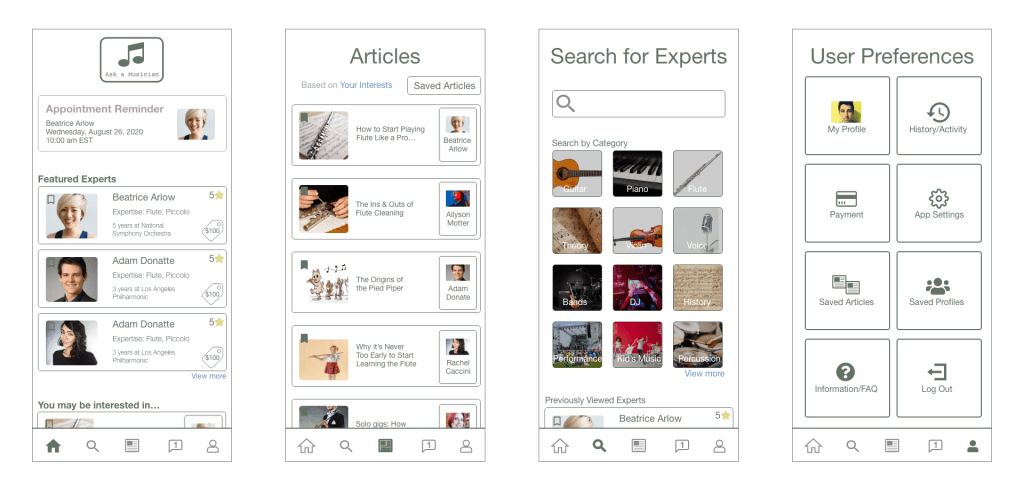
Changes to the navigation were included when I upgraded the application to high-fidelity wireframes. These wireframes were then linked into a high-fidelity prototype for usability testing.
Usability Testing
I conducted six moderated remote usability tests with my high-fidelity prototype. My goal for usability testing was to determine the learnability and efficiency as well as to eliminate any errors that could deter the usefulness of the mobile application. The usability tasks focused on onboarding, booking appointments, messaging, and searching for experts to book as those were the most important application features.
My two main objectives for the application were as follows:
- Determine the ease and experience users have while using the application
- Determine the ability and time for users to complete important tasks
Usability Testing: Results
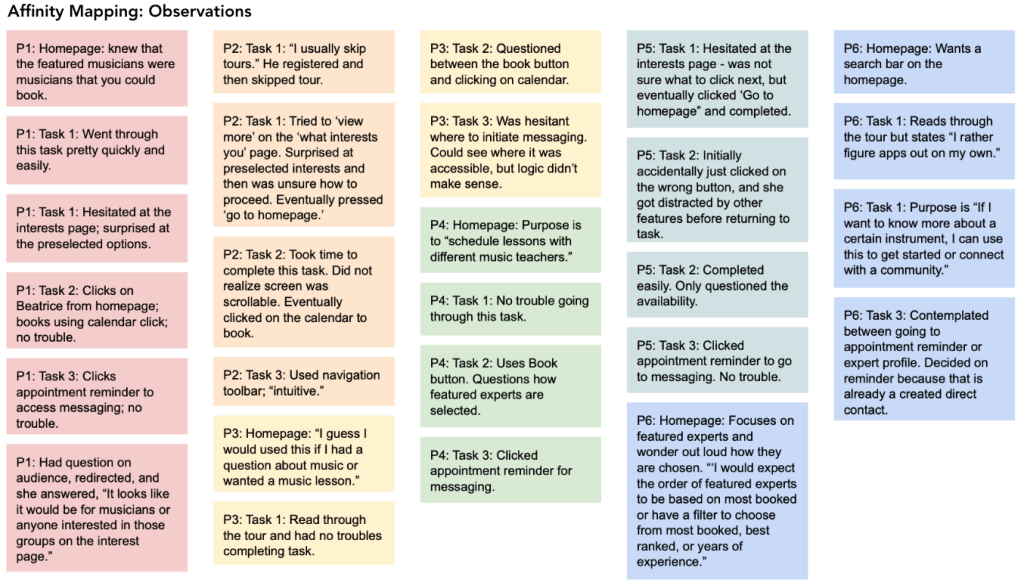
The six participants were categorized by color for affinity mapping, and observations, errors, positive quotes, and negative quotes from the six participants were mapped.

The affinity map of the observations below reference the usability test’s three tasks
given to the participants. The three tasks were:
- You just downloaded this mobile application and will be using this application to learn more about flute, how would you get started using this app?
- You are interested in learning flute, could you please find a flute expert and book an appointment with the flute expert?
- You have a question for the flute expert you booked an appointment with, how would you message them?
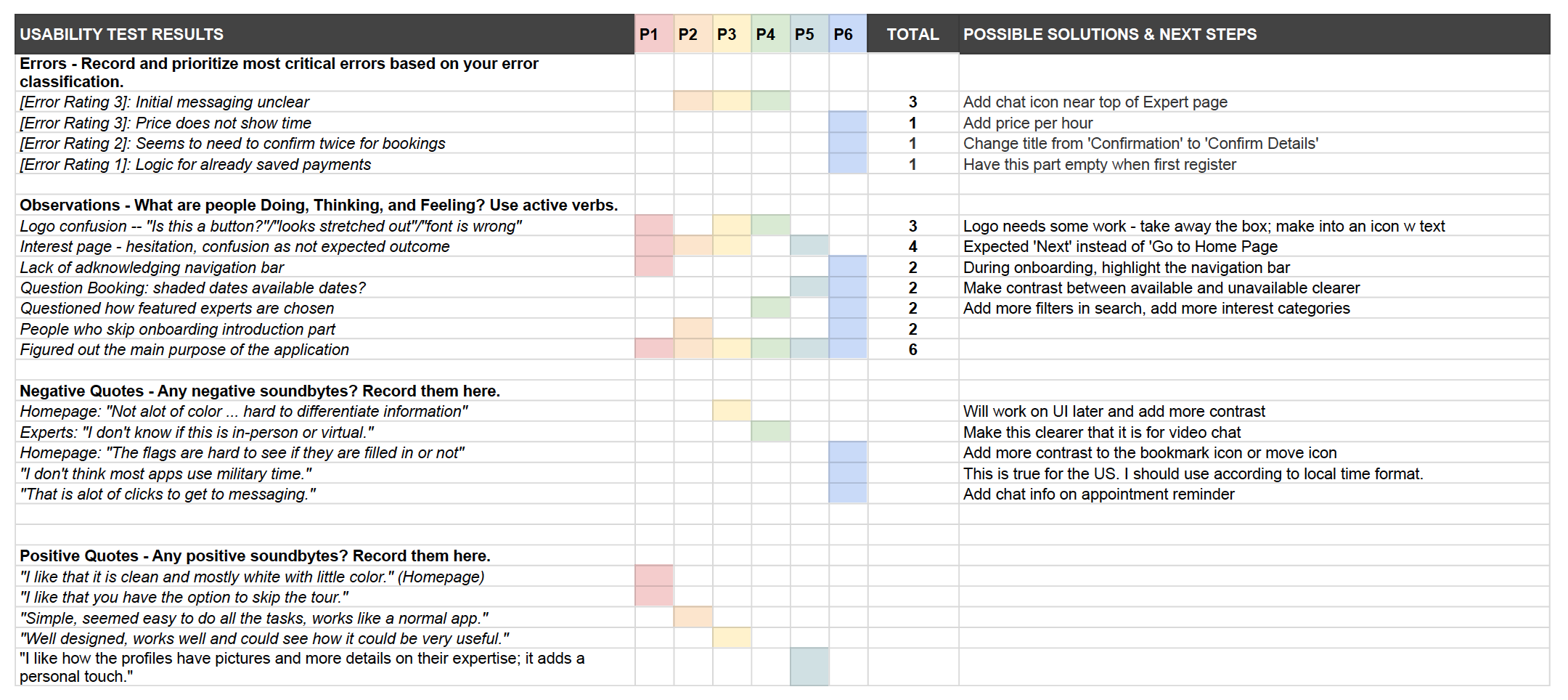
After affinity mapping the participant errors as well as the negative and positive quotes, the data was synthesized onto a rainbow spreadsheet. The Error rating scale was based off of Nielsen’s Error Severity Ratings, where an Error Rating of 4 was the maximum. The summary is shown below:
Insights:
Usability Testing
All participants stated that their experience using the mobile application was easy and straight-forward, and they were able to explain the purpose of the application correctly after the tasks.
Most of the errors found were minor errors that do not interrupt the usage of the application (shown on rainbow spreadsheet above).
Additional testing could be performed on the other features of the application, but the important features such as onboarding, booking an appointment, and messaging the expert are clear.
High-fidelity Wireframes Revisited
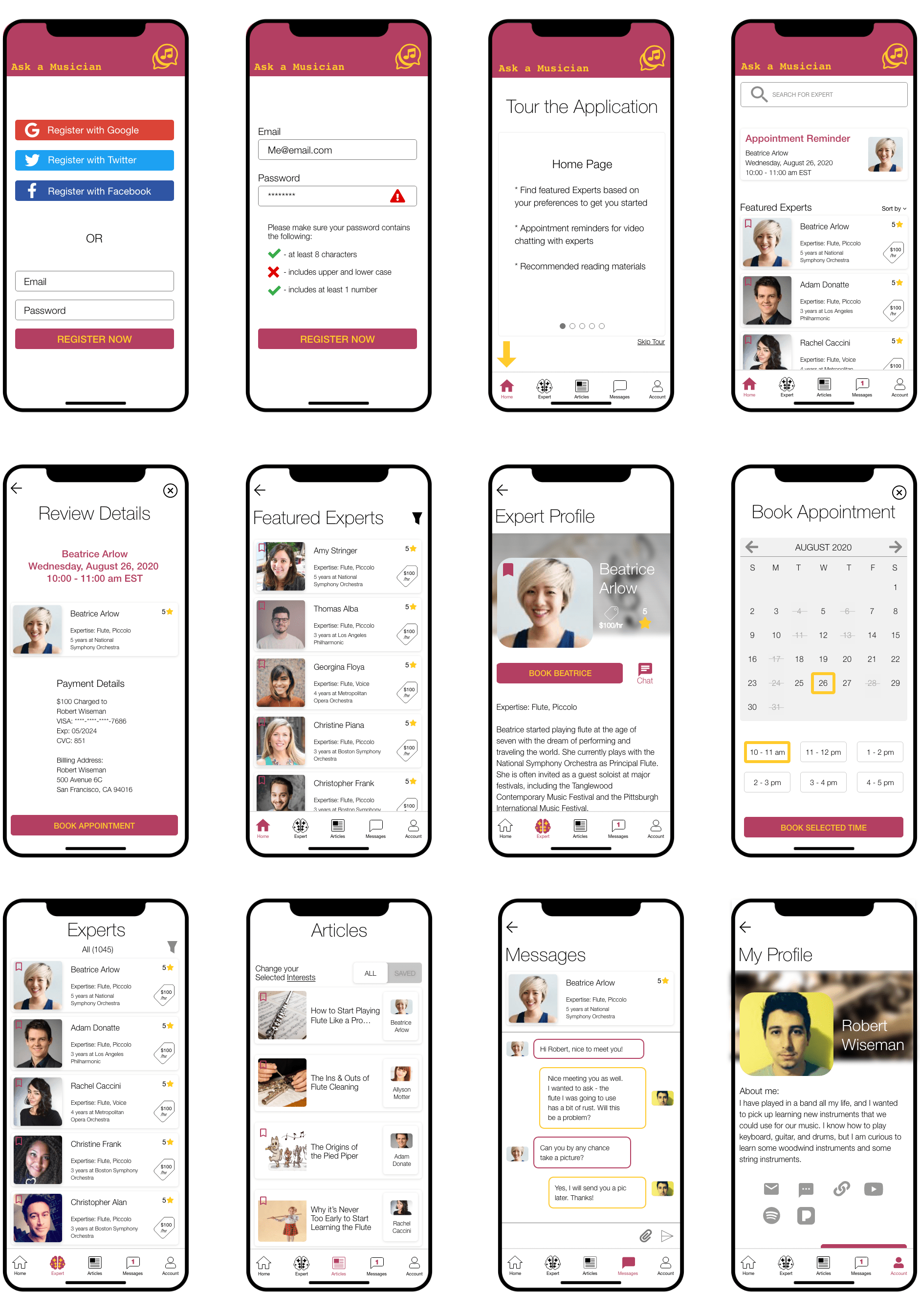
Adjustments to fix the usability testing errors were made for the high-fidelity wireframes. Other upgrades include an expert navigation icon instead of the search icon, a user friendly calendar for booking, and additional UI features.
Click Here for Prototype Video
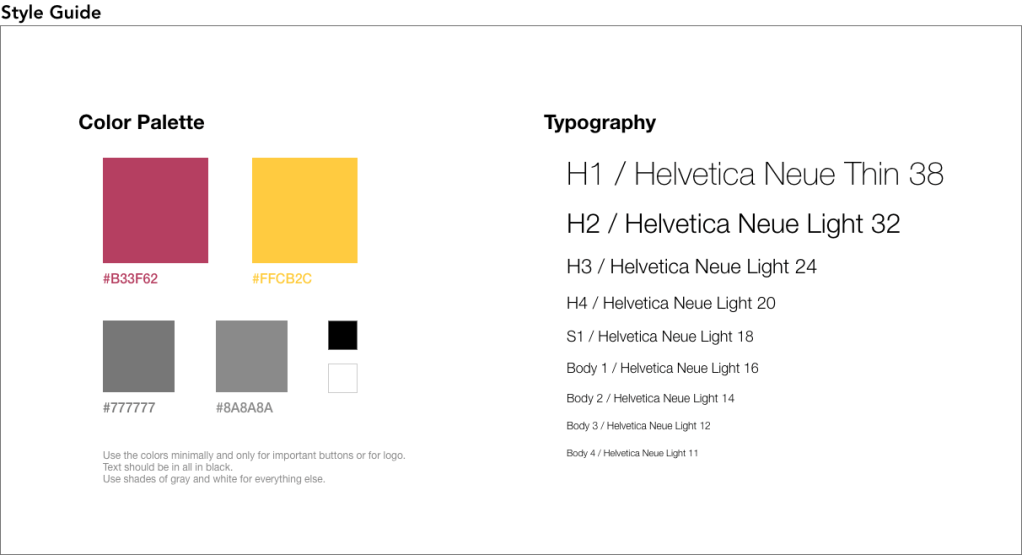
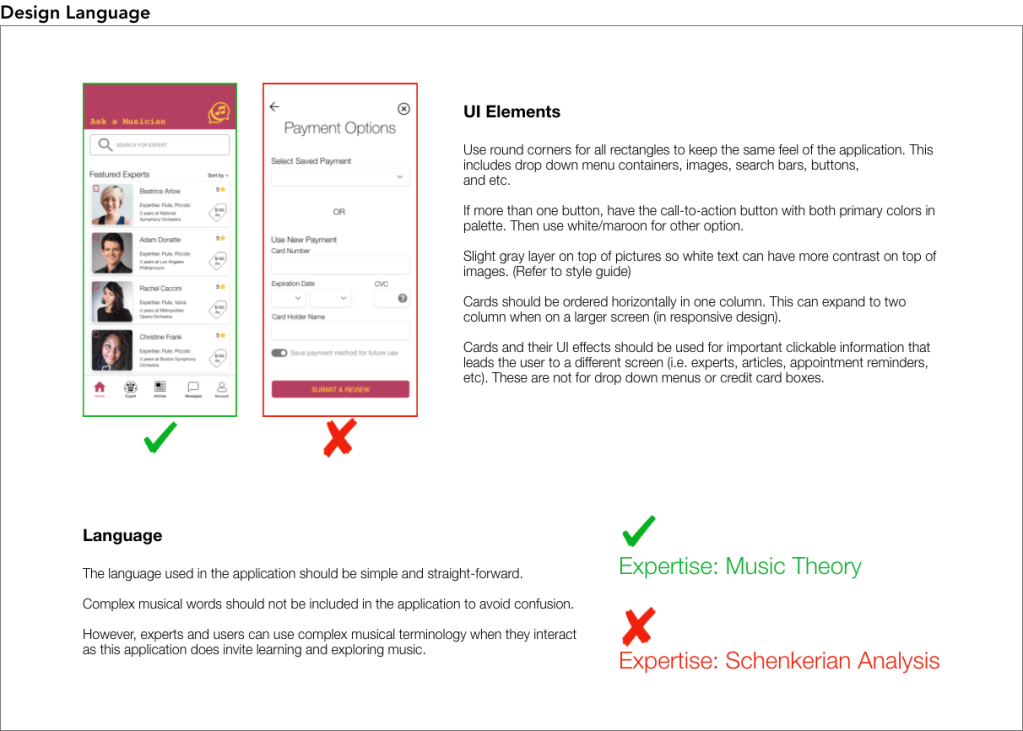
Note: selected parts of the Style Guide and Design Language instructions are featured below:
Insights & Future Directions
This application was intended for responsive design, so the next logical step would be to map out the element changes according to the grid changes responding to various screen sizes. In addition, many accessibility features could be included, such as autofill for search functions as well as a spellchecker for biographies on the profile pages.
While there were many improvements made due to my research endeavors in this case study, I do realize the limitations of using my own networks to find participants for my research. I did try to use people from different backgrounds for a variety of types of people. However, without proper resources, I was unable to find participants that I did not personally know, so there may have been some biases in my study. In the future, I do look forward to obtaining resources to conduct participant research with chosen unknown participants that would enhance the quality of my research.
I was unable to show in this case study all the process iterations I worked through with my course mentor as well as within the course requirements. Each iteration helped in improving the quality of the application as well as the usability. This is also one of the key ideas in User Experience Design that I recognized, where flexibility and an adaptive process is beneficial to a successful product. Therefore, I would also do more testing if I were given more time and resources for this study.
If you have additional questions about this project, feel free to reach out to me at Marcia.Hsu.UX (at) gmail (dot) com.
Thank you for reading!
 Marcia Hsu